
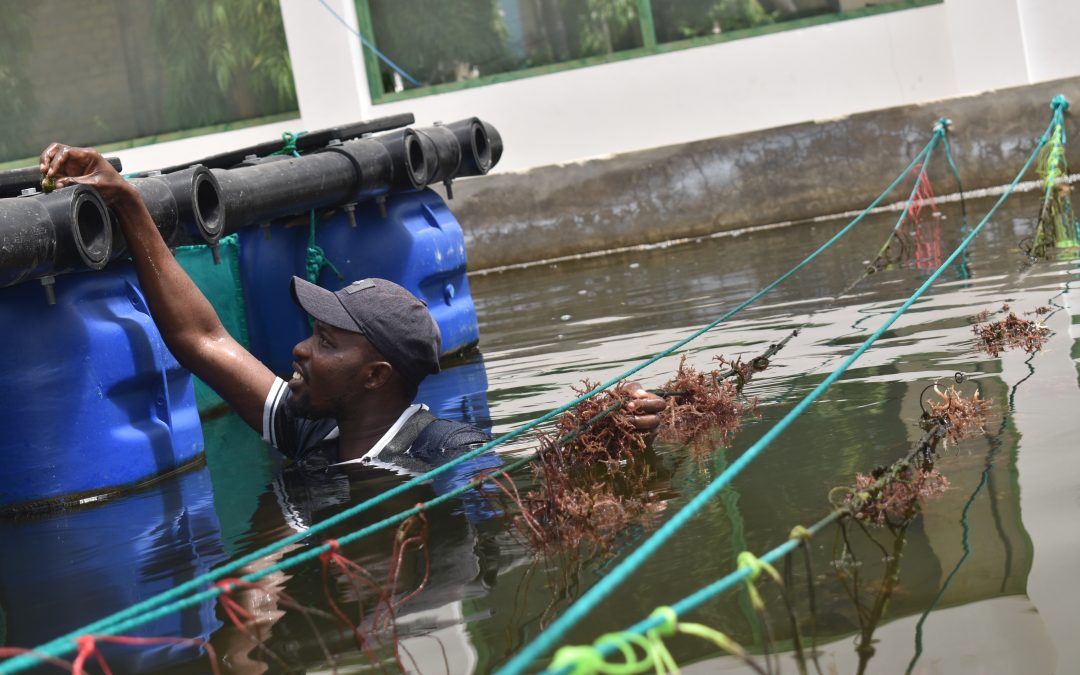
What if fish waste could become a resource rather than a problem? At Kwetu Training Centre, Integrated Multi-Trophic Aquaculture (IMTA) is demonstrating how different aquatic species can work together to improve production, reduce waste and create new livelihood opportunities for coastal communities.
For generations, fishing and aquaculture have supported livelihoods along Kenya’s coastline. However, increasing pressure on marine resources, rising production costs and environmental challenges are creating a need for more sustainable approaches to aquatic farming.
At Kwetu Training Centre for Sustainable Development, this vision is taking shape through its Integrated Multi-Trophic Aquaculture (IMTA) Hub, a demonstration and learning facility promoting resource-efficient aquaculture.
Unlike conventional systems that focus on producing a single species, IMTA integrates different aquatic organisms with complementary ecological functions. This allows waste and by-products from one species to become useful resources for another, improving nutrient recycling and resource utilization.
Kwetu’s IMTA demonstration brings together five aquatic species: tilapia, rabbitfish, oysters, sea cucumbers and seaweed. Each plays a unique role within the integrated production system.
Tilapia and rabbitfish are fed species that generate organic waste and dissolved nutrients. Oysters act as filter feeders, removing suspended particles from the water, while sea cucumbers consume organic matter deposited at the bottom. Seaweed absorbs dissolved nutrients, particularly nitrogen and phosphorus, supporting its growth while helping manage excess nutrients.
Together, these species demonstrate how different trophic levels can complement one another to support a more balanced production environment. Although IMTA does not eliminate all waste or replace proper water-quality management, it provides an opportunity to improve sustainability and reduce waste accumulation.
Beyond demonstrating an innovative aquaculture concept, Kwetu’s IMTA Hub focuses on transforming scientific knowledge into practical skills. The facility provides a learning environment where farmers, students, researchers and other stakeholders can understand integrated aquaculture through demonstrations, technical guidance and hands-on experience.
Through training and knowledge sharing, participants gain exposure to species integration, system management and the practical requirements of establishing aquaculture enterprises. The Hub also supports access to essential production inputs, including fingerlings and seedlings, helping make the technology more accessible to interested farmers.
For coastal communities, the benefits of IMTA extend beyond fish production. By integrating several aquatic species, farmers have the potential to diversify their products, strengthen household incomes and create additional business opportunities.
Instead of depending on a single harvest, farmers can potentially generate income from tilapia, rabbitfish, oysters, sea cucumbers and seaweed, depending on production capacity and market demand. This diversification can create multiple income streams while making better use of available resources.
The approach also presents opportunities for young people and coastal entrepreneurs to acquire technical and business skills, establish aquaculture enterprises and explore value addition. Sustainable aquaculture can further complement wild fisheries by providing alternative sources of aquatic products and livelihoods, potentially reducing pressure on natural marine resources.
Beyond its economic potential, IMTA creates opportunities for research, innovation and improved understanding of aquatic ecosystems. By demonstrating how different organisms interact within one production environment, Kwetu is contributing to conversations about responsible aquaculture and the future of coastal food production.
The future of aquaculture is not simply about producing more fish. It is about producing responsibly, utilizing resources efficiently and creating economic opportunities without compromising the environment.
Through its IMTA Hub, Kwetu Training Centre is connecting scientific knowledge with practical training, technical support and farmer engagement to introduce more sustainable production possibilities.
At Kwetu, the vision goes beyond fish farming: it is about making every resource count, creating opportunities for coastal entrepreneurs and building resilient livelihoods through sustainable aquaculture.