
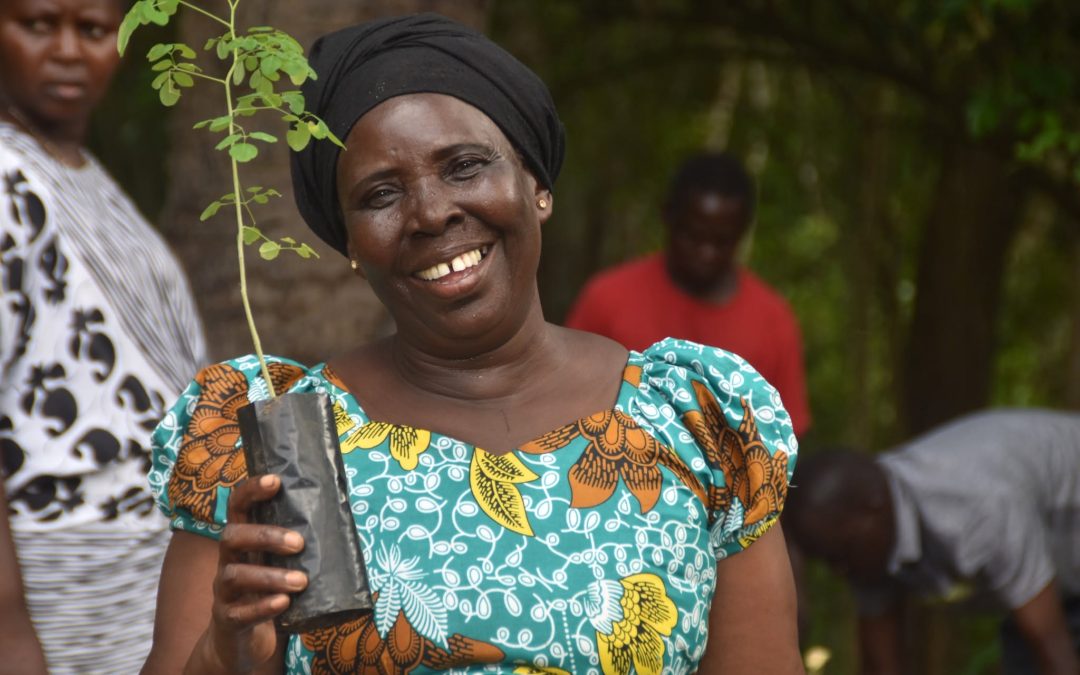
What happens when 20 trainers gain the skills to help hundreds of farmers adapt to climate change? Stronger farms, healthier soils and more resilient communities.
Climate change is reshaping agriculture, making sustainable farming practices more important than ever. In Kilifi County, where farmers face challenges such as unpredictable rainfall, soil degradation and declining agricultural productivity, building local capacity is key to securing sustainable livelihoods.
To address these challenges, KWETU Training Centre for Sustainable Development, under the Climate Agro-Resilient Livelihoods for Biodiversity (CARL-B) Project, conducted a four-day Training of Trainers (ToT) program on Sustainable Agricultural Land Management (SALM) from 27–30 October 2026, bringing together 20 trainers.
Equipping Trainers with Practical Climate-Smart Solutions
The training equipped participants with technical knowledge and practical skills in Climate-Smart Agriculture (CSA) and Sustainable Agricultural Land Management. Key areas included soil nutrient management, soil and water conservation, agroforestry, land restoration, integrated pest management, sustainable energy and integrated livestock management.
Through practical demonstrations and interactive discussions, participants explored affordable techniques that smallholder farmers can adopt to improve farm productivity while protecting natural resources.
Turning Knowledge into Action
From constructing Zai pits and fertility trenches to establishing contour bunds, mulching and harvesting rainwater, participants explored practical approaches to conserving soil moisture, improving soil fertility and reducing erosion.
The training also introduced agroforestry practices such as boundary planting, woodlots, alley cropping, fodder banks and integrating trees with crops and livestock. Other practical activities included composting, vertical gardening, Mandala beds and seedbed preparation.
Beyond technical agricultural skills, participants strengthened their facilitation, communication, adult learning and training evaluation competencies, preparing them to deliver effective and engaging learning experiences within their communities.
From 20 Trainers to Wider Community Impact
The real impact of the program extends beyond the training venue. The 20 trained trainers are expected to cascade their knowledge and skills to smallholder farmer groups through practical demonstrations, extension services and inclusive community learning activities.
By strengthening the capacity of local trainers, KWETU is helping create a pathway for wider adoption of sustainable farming practices, improved natural resource management and stronger resilience to climate-related challenges.
Because building climate-resilient farming communities starts with empowering the people who share knowledge.
ABOUT THE CARL-B PROJECT
The Climate Agro-Resilient Livelihoods for Biodiversity (CARL-B) Project focuses on strengthening climate-resilient livelihoods, promoting sustainable agricultural practices and enhancing biodiversity conservation. Through the SALM Training of Trainers program, KWETU Training Centre is building local capacity to advance sustainable land management and climate-smart agriculture among smallholder farming communities.